
 ZEPP Stores
Beyond CAC: A New D2C GTM Model
Customer acquisition cost for D2C brands in India has compounded steadily since 2023, driven by rising Meta CPMs, marketplace commission pressure and limited first-party data ownership.

In brief: Customer acquisition cost for D2C brands in India has compounded steadily since 2023, driven by rising Meta CPMs, marketplace commission pressure and limited first-party data ownership. This piece looks at why the standard fixes have structural limits and what a community commerce-based distribution model looks like as an alternative GTM approach for brands at scale.
Customer acquisition cost for Indian D2C brands has not just risen; it has compounded. In 2023, acquiring a customer in the Beauty and Personal Care (BPC) category cost roughly ₹800 - ₹1,200. By 2025, the same acquisition was costing ₹1,800 - ₹2,500*. That is not the kind of increase you optimise your way out of!
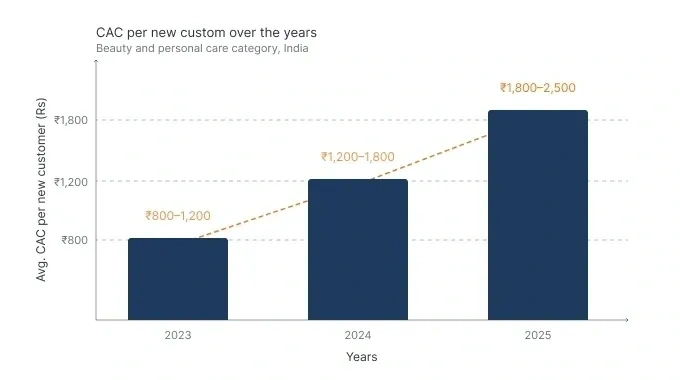
The instinct when CAC goes up is to improve the campaigns: better creative, sharper targeting, cleaner landing pages. These things help at the margin. What they cannot fix is a structural problem and the CAC problem in Indian D2C is structural.
What is actually driving costs up
The most direct cause is auction pressure. India added over 800 D2C brands between 2019 and 2024, and most of them are bidding for the same audience on the same two platforms. Meta CPMs in India rose 40 - 60% between 2023 and 2025. More advertisers, same inventory, higher prices. Dhruv Toshniwal, CEO of The Pant Project, described it plainly in an Exchange4media interview: "You are in a race to beat rising CPMs on Meta and Google and that is a battle that is hard to win at scale."
The second pressure is marketplace commission. Commissions, returns handling and fulfilment costs mean the revenue a brand actually sees from a marketplace sale is a fraction of the list price. When that margin is already compressed, paying more to generate the traffic that drives those sales makes the unit economics worse with every passing quarter.
The third is data ownership. Brands acquiring customers through advertising platforms or third-party marketplaces do not own those customer relationships. When a brand wants to run a re-engagement campaign or understand why a cohort churned, it is working with aggregated, lagged signals rather than first-party data. Over time, this forces brands to reacquire customers they have already paid to acquire once.
What an alternative GTM model looks like
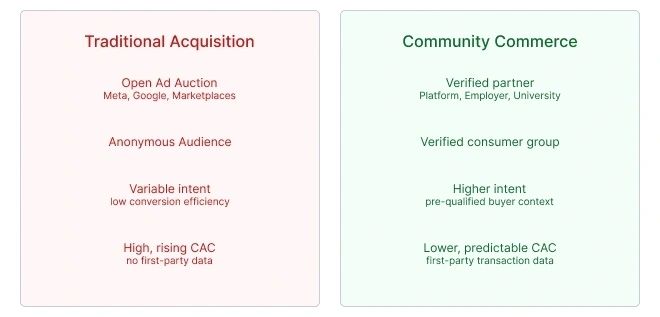
The acquisition model that sits furthest from the open-market auction is community commerce: reaching buyers through organisations that already have established relationships with them rather than competing for their attention in a public auction.
Employers, universities, fintech platforms and airlines already have defined, verified relationships with large groups of people. A brand that accesses those consumers through that relationship is not paying for discovery. It is paying for access to an introduction that comes with pre-existing trust and context, which is structurally different from the cost of media buying.
This model takes several forms in practice.
Employee purchase programmes (EPP) give brands access to corporate workforces through company benefits portals or HR platforms. The employer communicates the offer internally; the brand handles the product and fulfilment. No paid media is involved in the acquisition.
"ZEPP has helped us directly connect with corporate people while also guiding us on structuring the right deals. The support from the team has been excellent, making it a truly valuable platform for us." Ishita, Founder, Eat Atlas
Student purchase programmes (SPP) apply the same logic to university and institutional channels. Students are verified through enrolment credentials before accessing exclusive pricing, through a university portal or a platform integrated with institutional systems.
"Lenovo is committed to bringing education access to all with the help of smarter technology. We offer a wide portfolio enabling students to bring their best to the table. We have made available an extensive range of our Thin and Light, Gaming and 2-in-1 convertible laptops for students through the ZEPP programme." Hiral Somaiya, Country Head, Lenovo India
Super app and platform commerce embeds a brand's products within an existing platform's ecosystem, giving the brand access to the platform's verified user base without acquiring those users independently. IndiGo Shop is a working example in India: a commerce layer inside the airline's ecosystem connecting brands with IndiGo's frequent-flying customer base.
The infrastructure problem
The reason more brands have not moved in this direction is not strategic disagreement. The friction is practical. Running an EPP requires integration with corporate HR or intranet systems. A student programme requires institutional identity verification at scale. An embedded storefront inside a super app requires API integration with that platform's existing stack. Doing any of this bespoke, per partner, with a brand's own engineering team is expensive and slow.
Purpose-built commerce infrastructure addresses this. Platforms like ZEPP are designed specifically to provide this layer: API-first commerce infrastructure connecting brands with verified consumer communities, with native integrations into existing commerce stacks like Shopify and Unicommerce as well as custom integration with ERPs. A brand plugs into a demand ecosystem that has already been assembled, without rebuilding its catalogue management or fulfilment operations.
"The team has been flexible and responsive to our needs. Integrating our offers onto the platform has been a cinch. We have seen new customer acquisition through ZEPP across the segments they cater to." Apoorv Mangal, Founder, GoDS
The wider point
CAC is not going to come down on its own. India's digital ad market grew 19% in 2025 to ₹71,621 crore and e-retail advertising grew 56% in the same period#. More spend competing for the same attention means higher prices, not lower ones.
Community commerce offers a D2C acquisition path whose cost structure does not worsen with scale. The margin given to a verified community replaces media spend rather than stacking on top of it. Customer data is first-party and attributable. And the model scales by adding more partner channels, each with its own pre-existing audience, rather than by increasing ad spend.
For brands where the standard playbook is producing diminishing returns, that is the difference that matters.
ZEPP by ZRPL is a B2B2C commerce infrastructure platform enabling brands to deploy private storefronts for verified consumer communities, with native integrations for Shopify and Unicommerce as well as custom ERP integrations. Brand partners on ZEPP include Lenovo, Iluvia, Eat Atlas, GoDS and Tempt, among others.
* According to upGrowth's 2026 D2C Performance Marketing Playbook. # According to Dentsu's 2025 digital report
Get the next one in your inbox.
No spam - just occasional notes on the new commerce stack.